Why Reformer and Mat Classes Are One of the Best Things You Can Do for Your Body Right Now
Summary: If you’re experiencing perimenopause symptoms — brain fog, weight gain, anxiety, poor sleep or low energy — Pilates could be one of the most powerful tools available to you. In this post, Pilates Flow founder Anna shares her personal perimenopause journey and the evidence-based strategies that actually helped.
What Nobody Tells You About Perimenopause
I was a late bloomer. At 35, I finally took the leap into motherhood. The sleepless nights, the stress, the birth — I survived all of it and came out the other side feeling battered but proud.
What I was completely unprepared for was what happened a couple of years later.
I expected myself to bounce back as a fully functioning overachiever. Instead I got perimenopause brain fog at a level I didn’t know was possible. Not “where are my keys” brain fog. Kettle-on-the-stove-to-make-tea brain fog. Keys-in-the-fridge brain fog.
At home it’s almost funny. Out in the world — the world that expects you to be sharp and present and on top of everything — it’s frightening. Isolating. And nobody warned me it was coming.
Then came perimenopause weight gain that made no sense. I was training every 2nd day, eating well, doing everything right — and very little results. Because here is what nobody tells women clearly enough: when your hormones are not supporting you, losing weight is genuinely, physiologically difficult. This is not a willpower problem. This is biology.
And then the anxiety arrived.
I have the most wonderful husband imaginable. Gets up at 5 am to make breakfast, clean the kitchen and walk the dog. Patient, loving, never disappears at weekends.
I was furious at him for chewing his food.
That is what falling oestrogen levels do to your nervous system. Perimenopause anxiety doesn’t just increase — it gets absolutely supercharged. If you’ve ever snapped at someone you love for no reason and felt terrible about it — you might understand exactly what I mean.
This is not weakness. This is not who you are. This is perimenopause.
What Is Actually Happening In Your Perimenopausal Body
Understanding the science makes it so much easier to stop blaming yourself. Here is what is actually going on.
Perimenopause and Insulin Resistance
When oestrogen levels drop, the body can become less sensitive to insulin. Blood sugar becomes harder to regulate, cravings for sugar and refined foods increase, and the body becomes far more likely to store excess energy as fat. That never-satisfied, constantly hungry, constantly tired feeling? That is insulin resistance — and it is a hormonal reality, not a character flaw.
Perimenopause and Cortisol
Many women going through perimenopause are simultaneously managing poor sleep, hot flushes, demanding careers, busy family lives and relentless to-do lists. Every single one of these factors raises cortisol — the body’s main stress hormone. Elevated cortisol is strongly linked to increased abdominal fat storage, particularly visceral fat — the deeper fat stored around internal organs that carries greater health risks than surface-level fat.
Why does this matter? Visceral fat is associated with higher risks of:
- Type 2 diabetes
- Cardiovascular disease
- High blood pressure
- Fatty liver disease
This is why managing stress during perimenopause is not a luxury. It is an essential health strategy.
Perimenopause and Sleep Disruption
Hot flushes, anxiety and hormonal shifts disrupt sleep in ways that are genuinely unfair. And poor sleep doesn’t just leave you tired — research shows it actively increases hunger hormones, reduces feelings of fullness, ramps up cravings for high-calorie foods and reduces motivation to exercise. Poor sleep during perimenopause is not laziness. It is a hormonal cascade that makes everything harder.
Moving Less Without Realising It
Many perimenopausal women don’t exercise less — but they do tend to move less throughout the day without noticing. Small reductions in daily movement add up enormously over months and years. The solution isn’t always more intense exercise. Often it is more consistent, gentle movement woven through the day.
What Actually Helps — Evidence-Based Strategies for Perimenopausal Women
Here is the good news. Perimenopause weight gain and hormonal symptoms are common — but they are not inevitable. And the strategies that work are probably not the ones you have been trying.
Resistance training 2-3 times per week One of the most evidence-backed interventions for perimenopausal women. Building and maintaining muscle improves metabolism, supports bone density and genuinely changes how your body responds to hormonal shifts. This is where Reformer Pilates is particularly powerful — it provides resistance-based training in a low-impact, joint-friendly format that works beautifully for midlife bodies.
Daily walking Simple, free and profoundly effective for managing cortisol, regulating blood sugar and improving mood. Not as a calorie burn — as a nervous system reset.
Eating enough protein Around 1.2-1.6g per kg of body weight per day is the evidence-based recommendation for active midlife women. Protein supports muscle maintenance, keeps you fuller for longer and helps manage insulin resistance cravings. The aim is to nourish your body — not restrict it. Restrictive diets can actually accelerate muscle loss, which is the opposite of what perimenopausal women need.
Prioritising sleep Even small improvements to sleep quality create ripple effects across hunger, cravings, motivation and mood. Managing cortisol through movement and stress reduction can also meaningfully improve sleep.
Active stress management For a perimenopausal nervous system running on depleted oestrogen, stress management is not a nice-to-have — it is medicine. Pilates, walking in nature, mindfulness and time outdoors are all evidence-supported approaches.
Fibre, vegetables, fruit and minimally processed food Not a diet. Not a restriction. Simply nourishing your body with what it needs to regulate blood sugar and support gut health.
Why Pilates Is Particularly Effective for Perimenopause
The combination that research and personal experience consistently points to for perimenopausal women is strength training, walking and Pilates — and here is why that combination works so well.
Pilates — particularly Reformer Pilates — provides:
- Resistance-based strength training that builds the muscle mass perimenopausal women need to protect metabolism and bone density
- Breathwork and nervous system regulation that directly addresses the anxiety and cortisol elevation caused by falling oestrogen
- Low-impact joint-friendly movement suitable for bodies that may be experiencing increased inflammation or joint sensitivity
- Improved posture and core strength that supports the spinal changes associated with reduced bone density
- Mind-body connection that actively counters brain fog — you simply cannot zone out in a Pilates class
- Flexibility and mobility work that supports joint health and reduces the stiffness many perimenopausal women experience
Research from the University of Exeter shows that resistance training — which includes Reformer Pilates — is beneficial at all stages of menopause. The goal isn’t simply to weigh less. It is to lose fat while maintaining or building muscle — improving metabolism, supporting bone health, enhancing mobility and reducing the risk of age-related conditions.
Reformer Pilates vs Mat Pilates for Perimenopause — Which Is Better?
Both are excellent. Here is a simple guide:
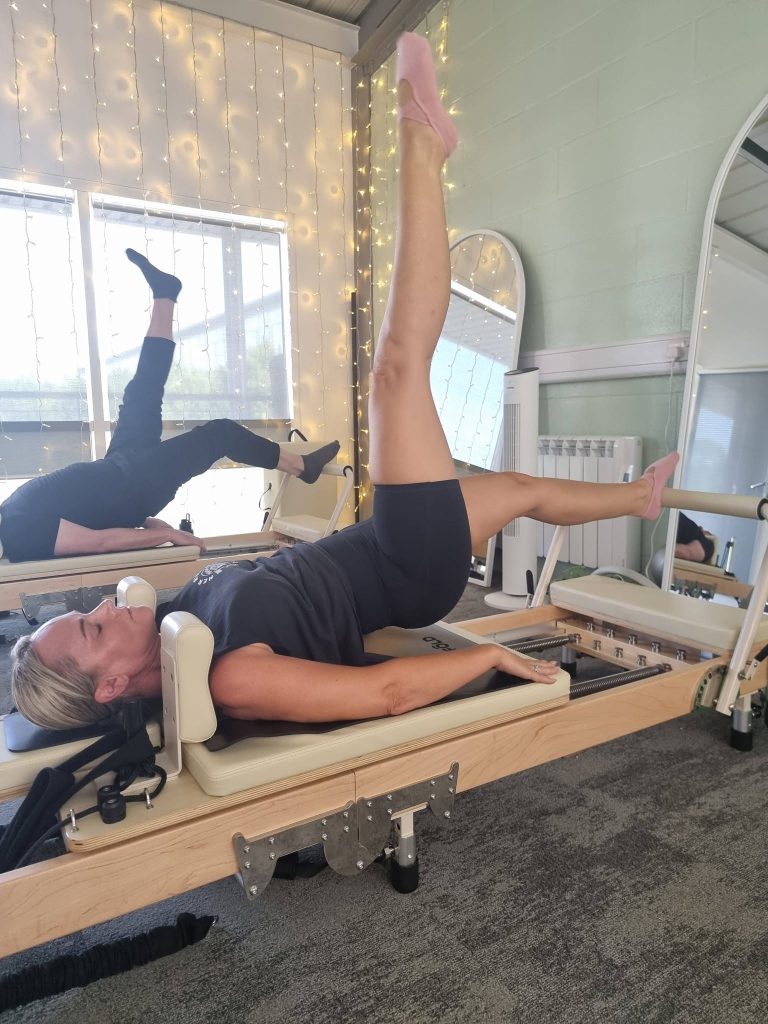
Reformer Pilates is ideal if you want progressive resistance training, are managing joint sensitivity or back pain, or want the most effective workout in the shortest time. The Reformer provides adjustable resistance through springs, making it highly adaptable to your energy levels on any given day.
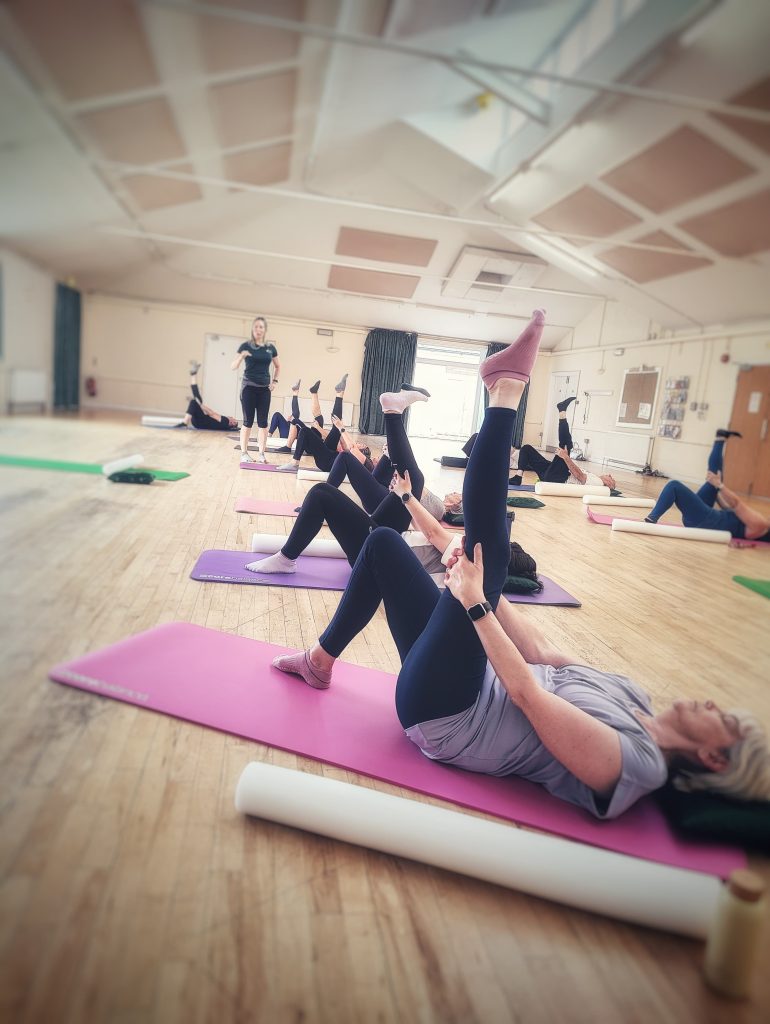
Mat Pilates is brilliant for accessibility, flexibility work and nervous system regulation. It also develops deep core stability and body awareness in a way that complements everyday movement.
At Pilates Flow, we offer both — and many of our members combine them for maximum benefit.
Where Am I Now?
In a much better place. 
The brain fog has lifted significantly. The insulin resistance is managed. The anxiety, while not completely gone, is no longer running the show.
And Bjorn can chew his food in complete peace. I genuinely consider that one of my greatest achievements of the last few years.
Getting here wasn’t one big dramatic change. It was consistent movement, a better understanding of what my body actually needed, letting go of the pursuit of a “perfect” body and focusing on how I actually feel — pain-free, mobile, strong and genuinely content.
That is what I want for every woman who walks through our doors.
Not a number on a scale. A body that feels like yours again.
Try Reformer or Mat Pilates in Quedgeley and Kingsway, Gloucestershire
At Pilates Flow, we offer small group Reformer (max 5) and bigger Mat Pilates classes with flexible class packs, no membership required, and a teacher who genuinely understands what perimenopausal women are going through — because she has been there.
We run almost 100 classes every month across morning, lunchtime, afternoon, evening and Sunday slots.
See you on the mat. Or the Reformer.